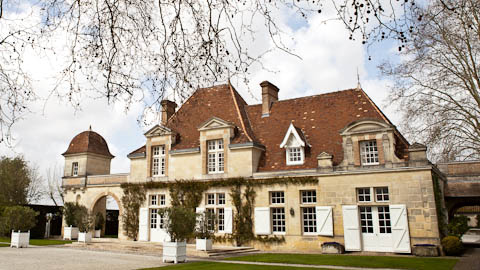
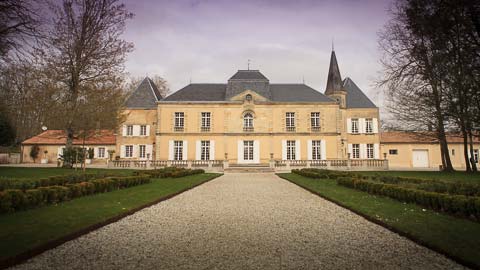
Chateau Lynch-Moussas was established in the 18th century, and originally was part of Chateau Lynch-Bages. The estate was classified in 1855 at which point it belonged to the Vasquez family. Then in the early 1900’s it was sold to Jean Casteja who unfortunately let the estate slide until his son Emile Casteja took over in 1969, while simultaneously running Batailley. Emile replanted the entire estate bringing the total area under vine to sixty hectares. Emile’s son Philippe Casteja now manages Lynch-Moussas with a clear ambition to improve the quality of its wines.
Bordeaux
Bordeaux
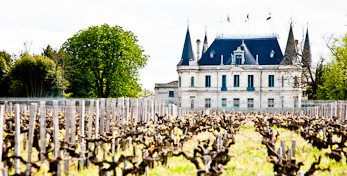
An enormous region producing large amounts of quality wine that was once the most favoured in these islands. Now, the top 3% of producers are the most privileged in the world, while the rest, as the market has expanded, have somewhat ironically lost market share to the sweetened fruit juice imported from other parts of the world. Affinity with Bordeaux partly stems from our historical ownership of it, while the Scots started drinking it to support later French owners in their wars against the English.
- Chateau Malartic-Lagraviere
At Leognan property Malartic-Lagraviere you are some distance from the Garonne, yet there are boats on the label of the wine. These honour a former owner, Count Hippolyte Maures de Malartic, an Admiral and a former governor of Mauritius. After the Maures de Malartic family, a hundred or so years with the Ricard family (who also owned de Fieuzal and Domaine de Chevalier) and a brief stint with Laurent-Perrier Champagne, since 1997 Malartic-Lagraviere has been owned and managed by the affable, very committed Bonnie family.
- Chateau Margaux
The history of chateau Margaux is as fascinating as any in the Medoc, but the second half of the 20th century is the key. For over two decades the Ginestet wine merchant family had the place, but presided over a severe decline - eventually they fell and were forced to sell. The run of dreadful 1970s vintages finally did for them. Andre Mentzelopoulos bought it in 1977, after it had been on the market for two years.
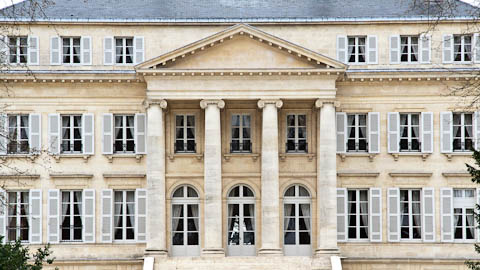
- Chateau Meyney
On the face of it Ch Meyney has an excellent position on the same gravel ridge as neighbour Montrose on the bank of the Gironde estuary, yet it has never achieved quite the same heights - or prices! It has a longer history than Montrose or many neighbours, being mentioned in the early 16th century nad being taken over by a reforming branch of the Cistercin order. The original buildings burned and the current ones date from 1662.
- Chateau Montrose
Before there were vines on the slope that now marks the vineyards of Montrose, there was heather. And at the right time of year, the hillside turned pink with heather flowers. Hence, Montrose – ‘mont rose’, ‘the pink slope’. Vines did not arrive here till the early 19th century, which makes Montrose one of the youngest classed growths. Yet it is also one of the best. It is often thought of as the first growth of St-Estephe, and frequently vies for the title of wine of the vintage.
- Chateau Mouton-Rothschild
Tasting en primeur, Mouton-Rothschild invariably seems to be opulent, rich, flambuoyant, the anitithesis of the other Rothschild First Growth, severe, austere Lafite. Mouton is one of the very few properties to be in the hands of the same family now as it was at the time of the 1855 classification (only Leoville and Langoa Barton enjoy that same historical continuity). Mouton took shape from the inheritance of Nicolas-Alexandre de Segur, who in his time had owned and created many of Bordeaux’s greatest estates. In 1720, one Joseph de Brane bought Mouton, and rechristened it Brane Mouton.
- Chateau PalmerNamed after one of Wellington`s generals, Charles Palmer owned this Chateau for nearly thirty years until 1843. A bit of a charmer, he intercepted the young widow on her way to the sale of her property and ended up with a bargain and who knows what else. Unfortunately, the general ended up as one of those who made a small fortune in the wine trade by starting out with an enormous one and his investments in Ch Palmer nearly bankrupted him. The only reason that Palmer has such a lowly position in the 1855 classification is that the subsequent owners had little time to put things right.
- Chateau Phelan Segur
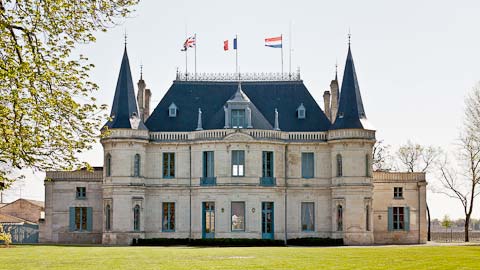
It is ‘a star in the appellation,’ according to Jane Anson, which would ‘make it into a new version of the 1855 classification if one ever came around’. Neal Martin calls it ‘quintessentially Saint-Estephe’. Quality is soaring at Phelan-Segur, and that is reflected in the scores it has been achieving. The terroir has always been good; the largest and best vineyard plot is adjacent to Montrose, although there is another excellent and significant section alongside Calon-Segur. While ownership changed in 2017, the steady hand of Director Veronique Dausse remained on the tiller.
- Chateau Pichon Longueville Lalande
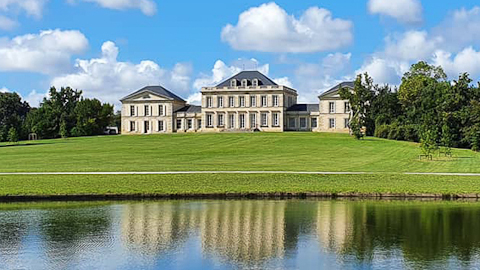
Pichon Lalande is easily one of the greatest wines of the Medoc, frequently vying with and sometimes exceeding the first growths in quality. It has its roots in the Pichon estate, which was split in 1850 into the two parts thereafter known as Pichon Baron and Pichon Lalande. From 1978 until 2007, Pichon Lalande was owned and managed by the redoubtable May Eliane de Lencquesaing. A powerful ambassador for Bordeaux worldwide, she oversaw many great vintages, the expansion of the vineyard and the rising profile of Pichon Lalande.
- Chateau Pichon-Longueville Baron
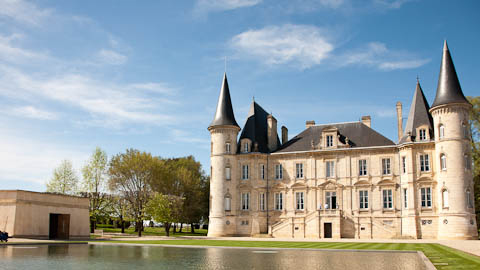
What is now Pichon Baron originally formed part of the same estate as Pichon Lalande. In 1850, on his deathbed, Baron Joseph de Pichon Longueville split his estate into two. 20 hectares went to his two sons, and were thereafter known as Pichon Baron, and 30 hectares went to his three daughters, and thereafter became Pichon (Comtesse de) Lalande.
- Chateau Pontet-Canet
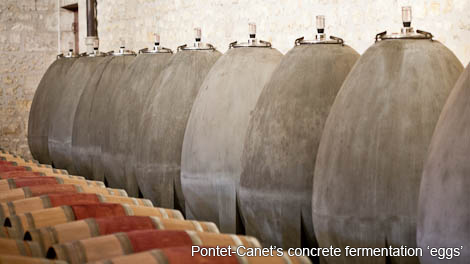
A powerful trend-setter, pioneering in its early adoption of biodynamics, over the last twenty years Fifth Growth Pontet-Canet has soared into the league of Super Seconds. Alfred Tesseron and Estate Director Jean-Michel Comme have unlocked the potential of this chateau whose vineyards abut those of Mouton-Rothschild, and the wines of Pontet-Canet demand serious respect, and time in your cellar.
- Chateau PotensacEven when the family already owns Leoville-Las Cases it does no harm to marry a lady with a very nice estate of her own and that is what Paul Delon did. It is quite a large property and like many at this end of the Medoc has gradually been planting more Merlot to take into account proper surveys of the land, which does have extensive clay deposits. Yields here are low by Medoc standards at a maximum of 35hl/ha and tannins are kept suave by a policy of cooler fermentation while quality is assured by the fact that almost half the production is diverted into the second wine.
- Chateau Rauzan Segla
Rauzan-Ségla is one of the finest properties in Bordeaux, occupying great terroir in Margaux, comfortably at the top of the table of Second Growths, and currently enjoying one of the great periods of its history after twenty years of investment and very focussed management. It emerged in the seventeenth century at the same time as many of the other great estates of the Médoc were taking shape. Inheritance divided the Rauzan estate into Rauzan-Ségla and the lesser Rauzan-Gassies in the early eighteenth century. By the end of the century, Rauzan-Ségla was famous worldwide.