Bordeaux
Bordeaux
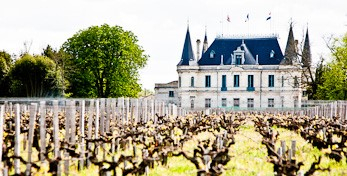
An enormous region producing large amounts of quality wine that was once the most favoured in these islands. Now, the top 3% of producers are the most privileged in the world, while the rest, as the market has expanded, have somewhat ironically lost market share to the sweetened fruit juice imported from other parts of the world. Affinity with Bordeaux partly stems from our historical ownership of it, while the Scots started drinking it to support later French owners in their wars against the English.
- Domaine de ChevalierNow you see it, now you don`t. Vineyard or pine plantation? However since the late 1860s this has been a wine estate and in both red and white wines a hugely successful one. There is one fly in the ointment though, like Volnay and Pommard, their particular micro-climate seems to attract incredibly localised hailstorms. Not desirable. Otherwise the estate fashions its highly praised wines from, for the reds, a 65% Cabernet Sauvignon, 30% Merlot, 3% Petit Verdot and 2% Cabernet Franc mix, though obviously the proportions vary from vintage to vintage.

- Domaine de l`Eglise
While it’s odd (though not unique) to find a winery in Bordeaux referred to as a ‘domaine’, the full official name of this property is actually Chateau du Domaine de l’Eglise. Either way, it’s the oldest property in Pomerol, with records that date it to 1589, when it was a hospice for lepers. The church it was named after no longer stands. When the Casteja family of wine merchants acquired Domaine de l’Eglise in 1973, that was the first time it had changed hands since the Revolution. The vines are well-sited, some next to the chateau, some on the plateau around Clinet and L’Eglise-Clinet.
- L`Hetre
The Cotes de Castillon lies on the eastward extension of the plateau underpinning St-Emilion. The soils in the area are mixed, but the high concentration of clay and limestone around what was then called Chateau Goubau caught the eye of none other than Jacques Thienpont, owner of Le Pin and L’If. ‘These soils keeps the roots of the vines cool, so the wines are fresh,’ says Jacques. When Chateau Goubau came up for sale, Jacques and his sister Anne de Raeymaeker pounced, and purchased it. Their first vintage was 2016. He named it L`Hetre, continuing his `family tree` motif.

- L`If
In 2010, Jacques Thienpont, the owner of Le Pin (the ultimate small estate with a big reputation) set out on a new venture, in St-Emilion. He acquired a small property called Chateau Haut-Plantey and set about re-building it from the bottom up. The soils had been treated with weedkiller and needed to be nurtured back to life. He uprooted the vines in three of the original five hectares, and replanted. He was able to acquire a couple of other plots to add in, which he thought would bring complementary qualities.

- Latour-Martillac
It’s got a 12th century tower, and it’s near the village of Martillac – the name of this Pessac property is virtually the address. This being Pessac, there’s both a red and white wine. The red vines are mostly planted across the gravelly soils of the Martillac plateau, while the white vines and the Merlot are planted across a clay-limestone outcrop. In reds, the vineyard is split 55% Cabernet Sauvignon/40% Merlot/5% Petit Verdot, and in whites 60% Sauvignon Blanc/40% Semillon. There are some venerable Semillon vines that date all the way back to 1884.
- Le Pin
Today, Le Pin is such a well-established member of the pantheon of the world’s greatest wines, it’s interesting to recall that it wasn’t always thus. Under its previous owner, a Mme F Loubie, the wine had been blended with lesser wines and sold exclusively in Belgium as Clos du Pin. Mme Loubie wanted to sell it to Leon Thienpont so that he could join it with Vieux Chateau Certan but, with six children to support, there was no way Leon could afford it. In 1978, Mme Loubie died.

- Smith-Haut-LafitteDaniel and Florence Cathiard`s wines have reached new heights in recent years as the couple have pushed through change and renovations in the vineyards and now have a fully functioning new winery for the second wine - Les Hauts de Smith. Not only is this fully equipped for producing high quality wine in small plot-based parcels as slowly as necessary, but is carbon neutral, even to the extent of capturing the carbon dioxide from the fermentation process.

- Tronquoy-LalandeIn a sense Bordeaux is like the Football League, where the arrival of a wealthy owner combined with bringing a retired superstar manager out of retirement can transform the fortunes of an estate. So it is here, as the Bouygues (think Ch Montrose) squillions combine happily with the skills and subtlety of Jean-Bernard Delmas – late of Haut-Brion to make the most of the fantastic gravel soils. This is a property where the Merlot and Petit Verdot have formed a majority coalition, keeping the Cabernet Sauvignon in a minority and the result is a wine of depth and finesse. (CW 21/05/10)
- Vieux Chateau Certan
After Petrus, perhaps no other Pomerol property attracts so much reverence as Vieux Chateau Certan. It certainly has an enviable location, plum in the heart of Pomerol and surrounded by the greatest names of the appellation. And the name of VCC itself? Certan was once Sertan, and may derive from a Portuguese word for desert; Portuguese travellers are said to have so named the area when they passed through in the Middle Ages. And there certainly is an old chateau on the estate.

