Italy
Italy
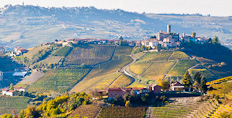
Italy is a large country filled with vines - up to nine hundred different varieties according to some sources. So we won't attempt to try to unravel its mysteries or complexities in a couple of paragraphs here, sign up for one of our courses for that! Suffice to say that the hottest part of Italy is often in the north, and that bits of the country you've never heard of make some of the best wines.
You may think Italians are an argumentative bunch only concerned with finding a way round the rules and I couldn't possibly comment, but it's the other half who have spent months meticulously drafting and redrafting those rules in the first place, and firmly believe they're the most important part of life. In every respect Italy is infuriating and seductive, so watch out, it may become a bigger part of your life than you intended!
- Piedmont & the northwestPiedmont is situated east of Turin and on the same latitude as Valence in the northern Rhone, but at a slightly higher altitude. The star turns are Barolo and Barbaresco, both made from Nebbiolo, but Barbera and Dolcetto are very worthwhile grape varieties too. Personally I`m less convinced by the whites but there are good examples of Arneis and Cortese to be found as well as the world`s most misunderstood grape variety- Moscato, most notoriously from Asti. This is a region where wines have improved enormously over the last few decades with many new producers, many ex co-op members now bottling their own wines. It has also provided many opportunities for internecine strife as some take modern to extremes, while others want to be the best in more traditional styles. The hills of Piedmont and Nebbiolo were made for one another with the late flowering grape`s thick skin protecting it from the autumnal fogs from which it takes its name. (CW 23/01/12)
- Veneto & northeastThis cover several regions and many different styles of wine, from the plains of Veneto itself, to the rolling hills of Friuli and onward to the alps and their foothills represented by Trentino and Alto Adige, the latter also known as Sud Tirol to its formerly Austrian inhabitants. It only became part of Italy less than a century ago. Wine styles encompass everything you can think of from the weediest and most dilute wines from those plains, to the most vibrant whites and intense and concentrated reds from the hills. Around the food capital of Italy, Bologna, there is Lambrusco – yes, I know, but the best is a great accompaniment to the local food. Being Italian of course, this immense area boasts many indigenous grape varieties and provides wines for every occasion and some of the best known in Italy and most obscure too. (CW 23/01/12)
- TuscanyOne of the few bits of Italy that has had some consistent wealth over the centuries, and so ready for take-off when Italy`s wine industry changed gear after the second world war. Mistakes were made and the one that is taking longest to repair is the clonal selection of Sangiovese, but gradually the high yielding vines are being swapped over for high quality ones. Sangiovese is the life blood of much of central Italy and provides the heart of Chianti and Scansano, all of Montalcino and Montepulciano and much else too. It isn`t the whole story as the northen coastal strip of Bolgheri provides terroir close to that of Bordeaux and much Cabernet, Merlot, Petit Verdot and so on are grown here. White wines are a different matter – not historically taken very seriously. But improvements are being made here and even around San Gimigniano you can find wine to drink. Other white to look out for includes Vermentino from near the coast. (CW 23/01/12)
- Central ItalyFor red wines two varieties dominate, Sangiovese and Montepulciano, which is one of the great confusions of Italian wine. Where in the name of the wine does Montepulciano appear? If it says Montepulciano di something, or just appears in the list of grape names then it is a grape. If it is di Montepulciano, then it`s the place, a fab village in Tuscany. Umbria has Orvieto through Sagrantino, the light white from the south contrasts with the huge red from the north. Abruzzo has Montepulciano (the grape) and the best, some would say the only drinkable Trebbiano in Italy. Lazio has some interesting emerging wine regions in the north, centred on Castiglione in Teverina – also part of the Orvieto zone. And to a lesser extent Viterbo, as well as the Est, Est, Est of Montefiascone, which is also showing signs of improvement. Top producer in northern Lazio is Riccardo Cottarello, one of Italy`s high profile wine consultants as well as owner of Falesco. Southern Lazio supplies oceans of Frascati to help keep hot and sweaty Rome refreshed. (CW 23/01/12)
- Southern Italy & the islandsLet`s start with Sardinia. When it ruled Spain it got Garnacha as part of the deal, though it is called Cannonau on the Island and Vermentino is the local white. Most of the vineyards are towards the south, though there are some on the northern coast too. Sicily`s wines are a complex as its history and the array of grape varieties, both autochthonous and international (French) reflects the inward looking yet outward facing community as well as anything. Great, if somewhat courageous use is made of Etna as a cool climate zone, while there are warm areas aplenty too. Well woth exploring. Southern neighbour Pantelleria specialises in sweet wines, especially from the Zibibbo variety. Back on the mainland, Calabria in the toe of Italy is probably the least developed part of the country and its production is co-op dominated, and not in a good way. Puglia`s co-ops next door have embraced change and make vast quantities of good value wines for supermarkets in northern Europe and North America, often under the auspices of flying winemakers from the southern hemisphere. Basilicata and Campania both produce bulk wine but have amazing pockets of the highest quality wines, mostly made from Greek vines introduced when they ruled the southern part if Italy, calling it Enotria in tribute to its vinous potential. (CW 23/01/12)