Spirits
Spirits
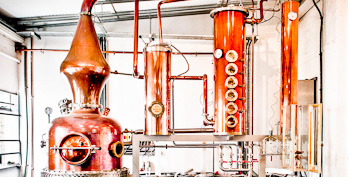
All thanks to our friends the Greeks, Egyptians and Arabs, who between them sorted out the technology, then brought it to Europe where we could appreciate its possibilities!
- Malt whiskyA spirit made from malted barley, subsequently brewed into beer and then distilled, usually in single batches in a pot still. It has been said that Scots make so much beer into whisky because it is so bad. The whisky must age for at least three years before it can legally be sold. No new barrels are permitted, with most Malt aging in former Bourbon casks, a minority on former sherry casks. A very few Malts are transferred to other more exotic casks for a short time to give them a `finish`. These have included Port, Sauternes, Syrah and so on. The vast majority of Malt whisky is used in blended scotch, though we see a lot of distillery and independent bottling. (CW 23/01/12)
- Grain whiskyGrain whisky is the basis of most blended scotch and is usually made in the south of Scotland in continuous stills and aged in Bourbon or Sherry barrels. A tiny amount is bottled as single grain, but this is rare. (CW 23/01/12)
- BourbonThis American whiskey need not be made in Kentucky but must be at least 51% corn, though in practice most comfortably exceed this. It must be aged for at least two years though much longer is desirable. (CW 23/01/12)
- Blended WhiskyBlended Whisky is a skillful amalgam of grain and malt spirit.
- Brandy - CognacCognac is an area north of the wine producing areas of Bordeaux` right bank. The production is mostly from Colombard and Ugni Blanc, vinified and twice distilled in pot stills before aging. There are various categories with minimum age limits. VSOP (very special old Pale) must be at least four years in cask, while XO must be at least six, though this will change in 2016 to ten years. Production is dominated by a few large companies, though much growing and distilling is done by farmers. The terroir is considered very significant in Cognac, with Grande and Petite Champagne the chalkiest and best. Cognac tends to the smooth and rich with age, a la Frapin, though it can be more delicate as in Delamain. Vintages are rare. (CW 23/01/12)
- Brandy - ArmagnacArmagnac is nowadays the poor cousin of Cognac, but prior to the second World War it was the brandy of choice. The grape varieties are Baco 22A, Colombard, Ugni Blanche and Folle Blanche and it grows mostly on chalky clay soils. The grapes are vinified, then distillation takes place in a continuous still, rather than a pot, as in Cognac. The oak used tends to the larger pored, so maturation is faster than that of Cognac. The typical characters of Armagnac are earthiness, fire and fruit, making it a more elemental spirit than Cognac. For some reason, many people find themselves less affected by indigestion from Armagnac drinking than Cognac. (CW 23/01/12)