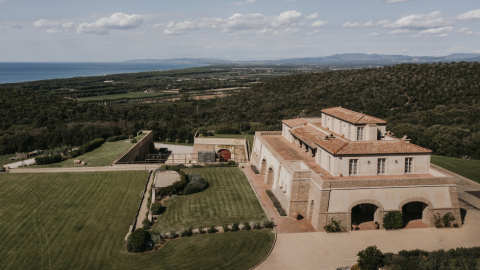
The small Tuscan coastline appellation of Bolgheri has had a disproportionate impact on the modern Italian wine scene. Its success has been in exploiting the remarkable affinity between Bordeaux grape varieties and Tuscan soils. Argentiera were founded here in 1999, and have since become one of Bolgheri’s reference estates. The Argentiera estate comprises 153 hectares (85 planted to vines) at the very southern end of the appellation, and which are among the highest vineyards of any Bolgheri estate. Their Merlot is mostly planted on north-facing sites (to restrain its generosity) while Cabernet Sauvignon and Cabernet Franc are planted on south and south-west facing sites (to encourage ripeness). Bordeaux consultant Stephane Derenoncourt has been on board since 2003, and has helped guide the estate from a powerful to a more elegant style. Vinification takes place in a mix of steel and concrete, then the wines are raised in a variety of wood formats; the barrel cellars contain barriques, tonneaux and 3000-litre casks.
What Argentiera calls their signature wine, and the first wine they ever released, is the Poggio ai Ginepri. It’s a classic Bordeaux blend, typically 40% Cabernet Sauvignon, 30% Merlot, 20% Cabernet Franc and 10% Petit Verdot. The Poggio Ginepri vineyards are Argentiera’s lowest, planted on red, sandy soils facing west out to sea (which is only a kilometer away), and they tend to make a forward, approachable style of wine. From higher slopes, between open land and dense hillside vegetation, the vines for Villa Donoratico are planted on a mix of sandy and rocky soils. Villa Donoratico is typically a mix of 45% Cabernet Sauvignon, 30% Merlot, 15% Cabernet Franc and 10% Petit Verdot, and is a more structured wine. The Bolgheri Superiore comes from a sweeping hillside vineyard where the estate’s original vines were planted. Argentiera think of the Bolgheri Superiore as their flagship. The vineyard rises from 160 to 200 metres of altitude, and the rocky soils here are a blend of marl, shale and limestone. It is typically a blend of 46% Merlot, 43% Cabernet Sauvignon and 11% Cabernet Franc.
Ventaglio is a true, top-end SuperTuscan (priced to match). No blend, it is 100% Cabernet Franc, and I have never come across such a deliriously well-defined Cabernet Franc outside France; tasting the 2019 took me straight back to the tasting room at Vieux Chateau Certain. The small, single vineyard is planted in rocky clay soils which are packed with chalky cobbles; they vines are in concentric rows that radiate out from a single oak tree. That means that across the vineyard different rows have every possible aspect, from north to south and east to west. (In my head I can hear the mutters and grumbles of vineyard managers from more staid estates). And Argentiera also make excellent whites. Eco de Mare is a salty, citrus-driven Vermentino, the kind of wine that demands a plate of fish and (optionally) being on the seaside in Tuscany. Scenario Bolgheri Bianco is a more serious, textured Vermentino with the structure to support aging. It is fermented and aged in a mix of cigar-shaped casks and ceramic amphorae, and given 9 months aging on the lees. (NT 24/03/26)


